Nonwovens one of the main fibers - PET
Aug 31, 2021
Non-woven fabric is a common material in our life, which is widely used in a variety of life products. According to the application requirements, non-woven fabrics can be divided into durable and disposable application type two categories. Durable non-woven fabrics can be used many times, with certain service life, in clothing, home decoration, agriculture, industry, and other fields have a wide range of applications. For example, in recent years very popular environmental bags, many are made of non-woven fabric.
China's national standard GB/T 5709 -- 1997 "Terms of Nonwovens for Textiles" defines nonwovens as: "A sheet, mesh, or mat made of directed or randomly arranged fibers by rubbing, gripping, or bonding, or a combination of these, excluding paper, woven fabrics, knitted fabrics, tufted fabrics, and wet-fleeced felts. The fiber can be natural or chemical; They can be short fibers, filaments or fibers that form on the spot."
The word "cloth" may make people think that its raw materials are natural materials, but in fact, the three major fibers used to produce non-woven fabrics are polypropylene (63% of the total), polyester (23% of the total), and viscose (8% of the total), with the remaining 2% acrylic, 1.5% polyamide and 2.5% other fibers.
The polyester fiber fabric itself has water resistance, friction resistance, water resistance, wrinkle resistance, colorfastness, and other excellent properties, in the textile fabric is more and more widely used. Polyester fiber belongs to chemical fiber, is the modification of polyester, it improves polyester low moisture content, poor permeability, poor dyeing, easy to pilling, easy to stain, and other shortcomings. It takes (PTA) or (DMT) and (EG) as raw materials to prepare the fiber-forming polymer - polyethylene terephthalate (PET), which is esterified or transesterified and polycondensation reaction. It is a fiber made by spinning and post-processing.
The longitudinal section of PET fiber is similar to that of PTT fiber. Under the microscope, the cross-section of PET fiber is round, the longitudinal thickness is more uniform, the hairiness is less, and the surface is smooth. Because of the existence of benzene ring in PET molecules, it needs to be stretched after traditional melt spinning, so as to make it rapid crystallization, which can make the fiber orientation and crystallinity is high, the RESULTING PET fiber has high strength, good elasticity, excellent thermal setting performance, good heat resistance, acid and alkali resistance, and other properties.
Polyester fiber non-woven fabric is mainly used in the industry. For example filter materials, insulating materials, cement bags, geotextiles, coated cloth, etc. In building construction, the polyester non-woven fabric can be used as a roof waterproof as a base cloth, with sand and cement attached above to prevent sand leakage.
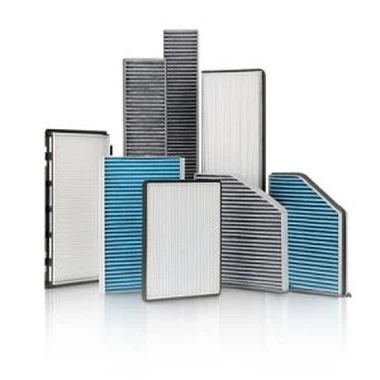
Hangzhou Srilan’s non-woven filter material is used in the production of coarse polyester staple fiber through carding process, we use 1D to 15D different diameters of fiber blend together, using the special formula, acupuncture method, bonding, melt method, such as production technology, and is widely used in bag filter, filter plate and frame type and coiling type filter. Flame retardant, antibacterial and colored support materials can also be produced according to different requirements of customers. These materials can be laminated with activated carbon materials or melt-blown materials of different filtration grades to form different filters.
With the development of science and technology and the improvement of people's requirements for the versatility of non-woven fabrics, the development of multi-functional, composite new fiber is the future direction of efforts. As a synthetic fiber, the efficient, low-carbon and environmentally friendly production of the fiber is the key to process improvement, and the recycling of the fabric also has a potential market value.