Basic knowledge about air filters
Nov 09, 2021
Air filter:
It is a device for collecting dust from gas-solid two-phase flow and purifying the gas through the action of porous filtering material. It puts the low dust content of the air purification treatment into the indoor, to ensure the process requirements of cleanroom and air cleanliness in the general air conditioning room, in the industrial link, many industries are used.
Main principles:
Air filtration mechanism mainly includes interception, inertial collision, Brownian diffusion, and static electricity.
(1) Interception and filtering:
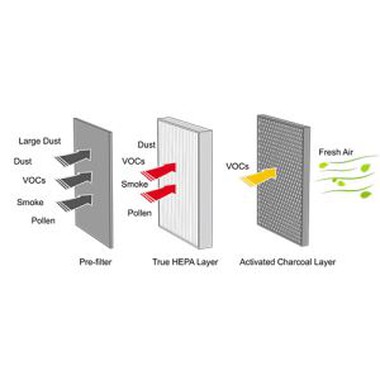
Interception filtration is the interception and filtration of larger particles in the air. When the air goes into the filter with the particles, the filter will intercept the particles higher than the sieve hole and then filter them out, and the particles smaller than the sieve hole will directly leak in the past. Therefore, usually, the primary filter is the use of this filter principle.
(2) Inertial impact filtration:
Large particles move with the flow of air, moving erratically through the air. The particle's inertia or some kind of field force deviates from the flow, does not move with the airflow, but collides with the obstacles and sticks to them, and then is filtered out by the filter. The larger the particle, the greater the inertia, the higher the filtration efficiency. Generally, coarse effect and medium effect filters are the filtering mechanism.
(3) Brownian diffusion:
Tiny particles in the airflow do random Brownian motion, collide with obstacles, and are stuck to hooks and filtered out. The smaller the particle, the stronger the Brownian motion, the more chances to collide with obstacles, and the higher the efficiency. It is also known as the diffusion mechanism. It is the filtering mechanism of sub-high efficiency, high efficiency, and ultra-high efficiency filters. The closer the fiber diameter is to the particle diameter, the better the effect is.
(4) Electrostatic adsorption:
Electrostatic dust removal technology uses the principle of high-voltage electrostatic adsorption to remove particulate pollutants in the air, such as dust, soot, pollen, cigarette smell, and kitchen smoke, etc. At the same time, it can also effectively absorb gaseous pollutants in the air and filter pathogenic microorganisms in the air.