SIMPLE INTRODUCTION FOR MERV
Mar 29, 2021
WHAT IS MERV RATING?
MERV = Minimum Efficiency Reporting Value The rating is the domestic and international industry-standard rating system established by the American Society of Heating, Refrigerating, and Air Conditioning Engineers.
WHY IS MERV IMPORTANT?
Indoor air pollution is considered one of the top environmental health risks. Indoor-house air quality is highly related to people's health and the HVAC air filter is the key factor to air quality.
Allergies, pets, odors, and smoking all can greatly affect the quality of your indoor air. >10um Particles be blocked by nose. 2.5-10um Particles be inhalable and enter the upper respiratory tract. The American Lung Association recommends using at least a MERV 8 filter.
HOW MERV RATINGS WORK?
ASHRAE created the MERV system in 1987 as part of their ongoing process to update their filter testing standard that was initially published in 1968. MERV ratings are based on how well an air filter traps common airborne pollutants within specific size ranges.
According to the National Air Filtration Association, there are 16 MERV values, from 1 to 16, with the tested filter efficiency increasing as the MERV number increases. Filters are tested against 12 size ranges of particles, with the smallest range being around 0.3 micrometers and the largest range around 10 micrometers.
To put these sizes in perspective, a micrometer – also known as a micron – is one-millionth of a meter. A strand of human hair is estimated to be 75 to 100 microns, so some of these particles can only be seen using a microscope.
To determine MERV, an air filter’s performance is determined by measuring the particle counts upstream and downstream of the filter being tested. Particle counts are taken over 12 specific ranges of particle sizes, during six testing intervals, beginning with a clean filter and then after periodic additions of a special ASHRAE test dust for five additional measurement cycles.
Particle density in the test duct is evaluated before and after it passes through the filter. Based upon defined calculations, as noted within the Standard, a specific MERV is assigned to the air filter.
A HIGHER “ MERV” RATING ISN’T ALWAYS BETTER
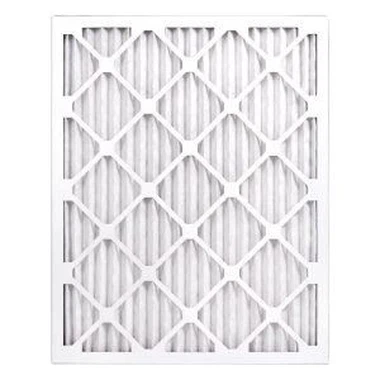
Furnace filters are “MERV” rated according to the size and quantity of particles they filter. The range is from 1 to 16, with 1 being the most porous and 16 the finest. One might think that the higher the MERV rating, the better. But for most homes, a filter in the 8 to 12 range is plenty good. It will filter the vast majority of airborne particles and protect your furnace components.
MERV filters rated higher than 12 plugs up much faster and need more frequent replacement. Only households with respiratory issues, serious allergies, or low-immunity issues should bother with them, and you have to stay on top of filter changes.